
Advanced Termite Questions - What Most People don't tell you
❓ Advanced Termite Questions (What Most People Don’t Tell You)
🏠 Is tenting (fumigation) really the best solution for termites?
A lot of homeowners immediately think about tenting when they hear the word “termites.” It feels like the strongest, most definitive solution — the idea that you cover the house, gas everything, and the problem is gone.
But the reality is more nuanced.
Tenting does not have a residual effect, which means that once the process is complete and the gas dissipates, there is no ongoing protection left behind. By law, fumigation cannot be used as a preventive treatment — it is strictly corrective. It addresses what is present at that moment, but it does not reduce risk of future infestations.
That’s why, in many situations, it makes more sense to start with treatments that provide a residual effect, such as liquid applications. These remain active after the treatment is completed and help create a protective barrier moving forward.
Tenting still has its place. In cases of widespread or heavy infestation, it may be necessary. However, even in those situations, it is often more effective when combined with other treatments. On its own, it does not provide long-term protection, and termites can return after the process is completed.
🟢 I see bait stations around my house — does that mean I’m protected?
This is one of the most common misconceptions we see, especially in newer construction.
Many homeowners assume that because bait stations were installed by the builder, the home is automatically protected. Unfortunately, that’s not how the system works.
Bait stations require ongoing maintenance. The cartridge inside the station typically lasts about one year underground. After that, it needs to be refilled or replaced. If it is not maintained, the system becomes inactive and provides no prevention.
What makes this important is the nature of subterranean termites. One home can be affected by multiple colonies, and those colonies can extend across multiple properties. It’s a very complex underground system, and because these termites are aggressive, you should not assume protection just because stations are present.
The recommended approach is to maintain and renew those stations annually, ideally for at least the first five years. When properly maintained, they can be very effective. When neglected, they give a false sense of security.
🧱 Should I do a local treatment or treat the entire structure?
It’s very common for homeowners to ask for localized treatment — treating just the area where activity is visible.
On the surface, that sounds logical. If the issue is in one spot, why treat the whole structure?
The challenge is that termites don’t operate in isolated areas. They travel. What you see is often just one visible point of a larger, hidden pattern of activity. If termites are present in one corner, there’s a reasonable chance they may be in other areas you cannot see.
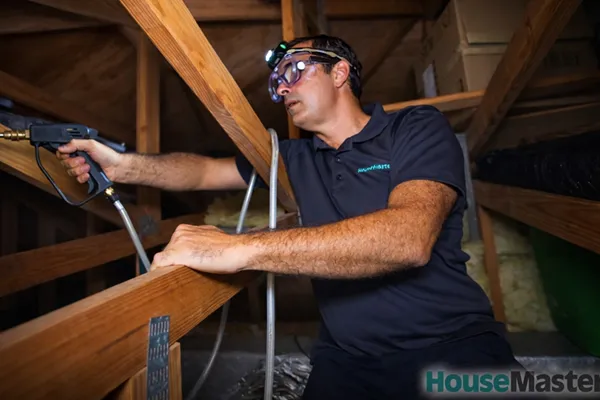
In our experience, especially with drywood termites, the attic is one of the most common places for activity. Infestations often begin around soffit and fascia areas, typically where there has been moisture intrusion or a small roof leak. Those conditions create an ideal environment for termites to establish themselves.
Because of this, once termite activity is confirmed, it is often more effective to treat the entire attic or affected structure rather than a single localized area. The cost difference is usually not significant compared to the benefit of addressing the broader risk.
🐜 If I have bait stations, do I still need additional treatment for subterranean termites?
In many cases, yes — because bait stations and liquid treatments serve different roles.
Bait stations are designed to work over time. They attract termites, allow them to feed, and then carry the treatment back to the colony. It’s a very strategic and effective method for addressing the source of the problem.
However, subterranean termites are aggressive. While the bait system is working to impact the colony, termites may still be actively feeding on the structure.
That’s where liquid or soil treatments come into play. These can be applied around the structure to create a barrier that helps reduce risk of ongoing damage while the bait system does its job in the background.
Using both methods together often provides a more balanced approach — one addressing immediate exposure, the other addressing the colony itself.
🍬 Why are bait stations so effective?
Bait stations are actually a very sophisticated system when you understand how they work.
They use a specially designed material — essentially a pre-digested wood product — that is highly attractive to termites. In many cases, it’s even more appealing than the wood in the home itself.
When termites begin feeding on the bait, they don’t die immediately. That delay is intentional. It allows them to carry the material back to the colony and share it with other members, including the core of the colony.
Over time, as the material spreads, it begins to affect a larger portion of the colony. This is what makes the system effective — not immediate elimination, but gradual and widespread impact.
Another advantage is that the treatment remains contained within the system and is less affected by environmental conditions like rain, making it a more targeted and controlled solution.
🧴 Can I stay in the home during liquid termite treatment?
Yes, in most cases you can remain in the home during treatment.
Liquid treatments are not volatile in the way fumigation is. They are applied directly to wood or targeted areas and do not create a gas that fills the home.
As a precaution, pets should be kept away from treated areas until the material has dried, which typically takes about an hour. After that, normal contact with treated surfaces is generally considered safe.
These treatments have been used for many years and are designed to target termites and similar organisms, while allowing normal occupancy of the home.
🔍 Can a home inspector guarantee that there are no termites?
No — and it’s important to understand why.
Termites are extremely small and often remain hidden inside wood, behind walls, or underground. Even with experience and a thorough inspection, it is not possible to guarantee their absence.
What an inspection provides is a professional evaluation based on visible conditions, signs of activity, and areas that are accessible at the time of the inspection.
Because of these limitations, no inspector can legally or practically guarantee that termites are not present. This is clearly stated in WDO reports and is part of the standard expectations of the industry.
📅 How often should I have a termite inspection?
In Florida, termite inspections should be considered part of routine home maintenance rather than a one-time event.
Given the climate and high level of termite activity, an annual inspection is recommended. Conditions can change over time, and early detection is one of the most effective ways to reduce risk and avoid more significant damage.
When you consider the typical cost of an inspection compared to the potential cost of repairs, it becomes a very practical investment.
The best way to think about it is simple:
👉 It’s not about reacting to a problem — it’s about staying ahead of one.
📞 Have questions or want guidance?
If you’re not sure what applies to your situation, that’s completely normal.
Every property is different, and the right approach depends on the conditions, history, and level of risk.
👉 We’re here to help you understand those factors and make informed decisions — without confusion.
📍 Termite Treatment in Broward
We provide licensed termite (WDO) treatment, including:
Fort Lauderdale & Wilton Manors
Hollywood & Dania Beach
Hallandale Beach & Aventura
Pembroke Pines & Miramar
Weston & Parkland
Davie & Southwest Ranches
Cooper City & Plantation
Sunrise & Tamarac
Coral Springs & Coconut Creek
Lighthouse Point & Lauderdale-by-the-Sea
Margate & North Lauderdale
Deerfield Beach & Pompano Beach
📍 Termite inspections in Orlando and surrounding areas
We provide licensed termite (WDO) inspections throughout Central Florida, including:
Kissimmee & ChampionsGate
St. Cloud & Davenport
Lake Mary & Sanford
Oviedo & Waterford Lakes
The Villages & Leesburg
Clermont & Minneola
Mount Dora & Eustis
Winter Garden & Celebration
Winter Park & Maitland
Altamonte Springs & Longwood